SCaMP: An Improved Red Fluorescent Calcium Indicator for In Vivo Imaging
Published in Figshare, 2026
Abhi Aggarwal, Jeremy Hasseman, Amelia Waring, Jennifer Li, William Wright, Xingyang Fu, Abigail Stuart, Kui Wang, Luke Coddington, Jihong Zheng, Brendan Power, Daniel Reep, Arthur Tsang, Getahun Tsegaye, Genie Reagents, Ronak Patel, Yuanhua Wang, Zhengyuan Pan, Richard Ikegami, Sandeep Kumar, Daniel Bushey, Robert E. Campbell, Wyatt Korff, Yu Mu, Daniel Colón-Ramos, Joshua T. Dudman, Vivek Jayaraman, Takaki Komiyama, Kaspar Podgorski, Alison G. Tebo, Glenn C. Turner
DOI: https://doi.org/10.6084/m9.figshare.32141944
Abstract
Red-shifted genetically encoded calcium indicators (GECIs) enable multiplex imaging, allowing simultaneous measurement of neural activity across populations (e.g., GCaMP + red GECIs) or alongside neurotransmitter signals (e.g., iGluSnFR + red GECIs).
However, current red GECIs lag behind the jGCaMP8 family in key performance metrics and exhibit important limitations. For example, jRGECO1a undergoes blue-light-induced photoswitching, complicating optogenetic experiments, and, like other mApple-based sensors, can accumulate in lysosomes as bright, non-responsive species that elevate background and compress dynamic range.
To address these issues, we developed SCaMP, a red GECI based on mScarlet - one of the brightest red fluorescent proteins and one that does not photoswitch. SCaMP exhibits improved signal-to-noise and dF/F0 relative to prior red indicators, along with higher baseline brightness.
We demonstrate SCaMP across multiple in vivo systems - including Drosophila, C. elegans, zebrafish, and mouse - establishing its utility for multiplex imaging and neural circuit analysis.
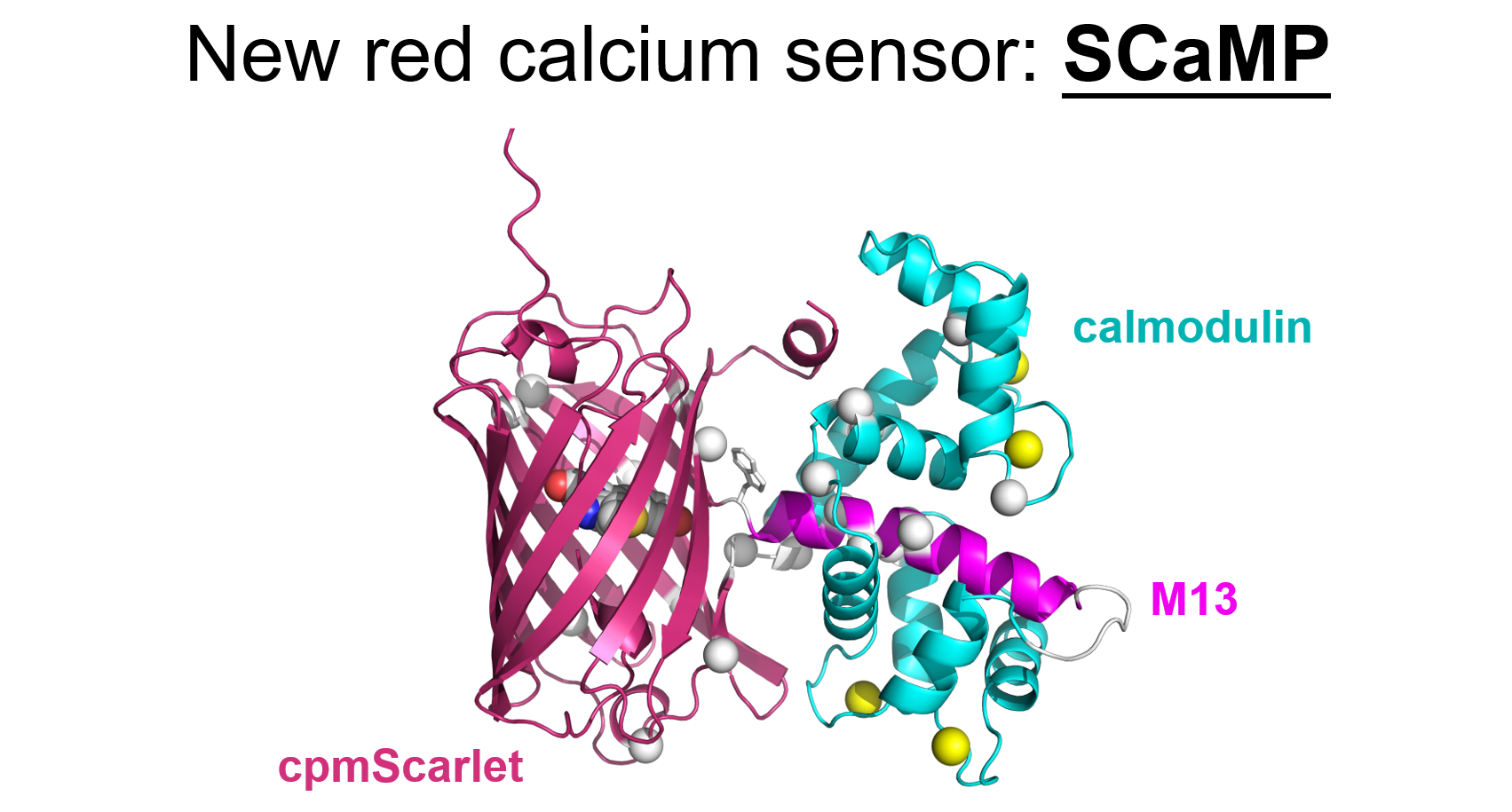
Initial design work varied topology, linker length and linker sequence to get a calcium-sensitive starting sensor
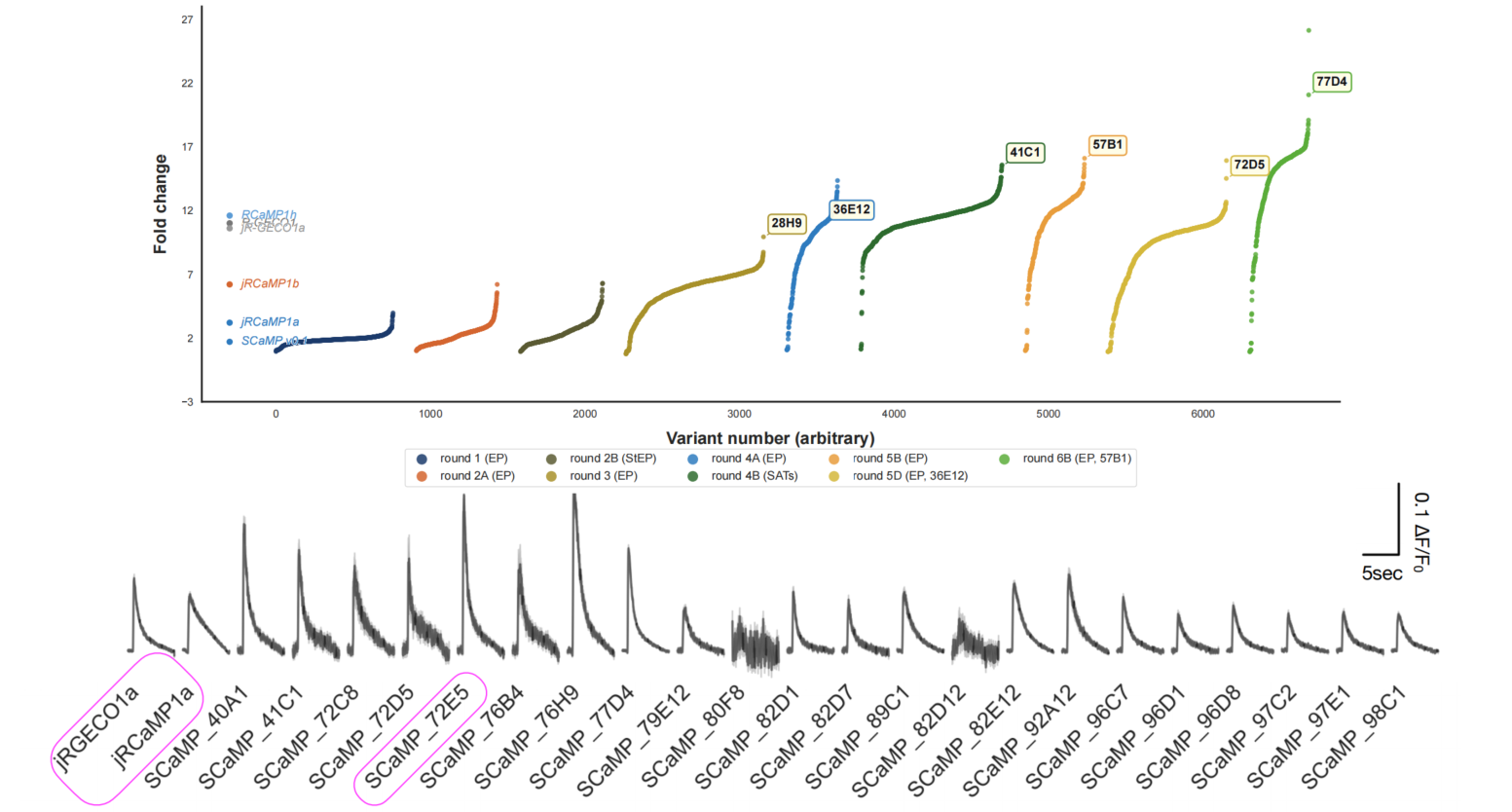
Directed evolution over 7 generations improved biochemical parameters of sensor (dynamic range, calcium affinity etc.) to be superior to existing red CaMPs
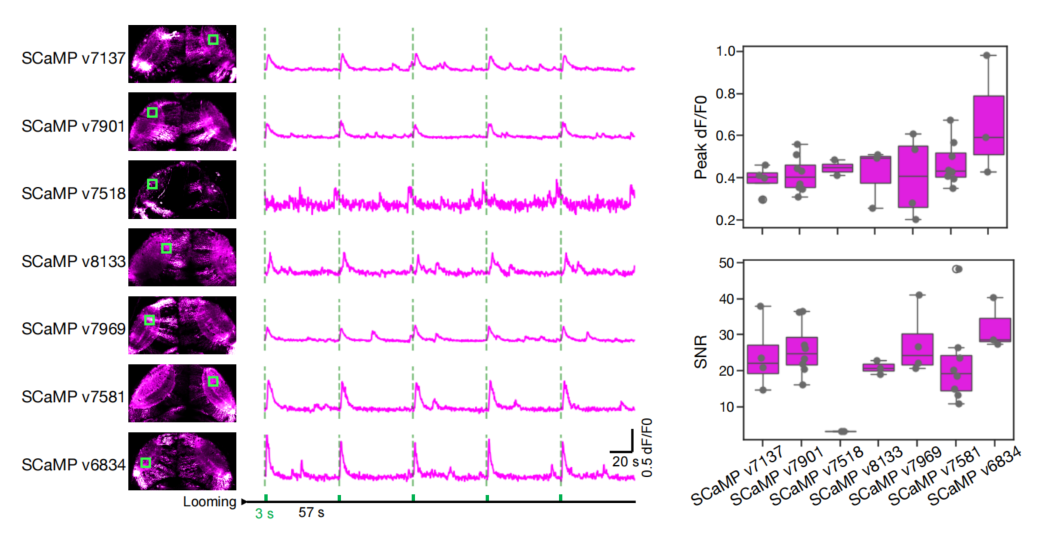
Top-performing SCaMP variants were screened using looming stimuli to probe visual responses
Orginal link: Figshare Preprint